
If Then Blocks#
if / else blocks are a way for your robot to make decisions during a project.
Understanding if / else blocks#
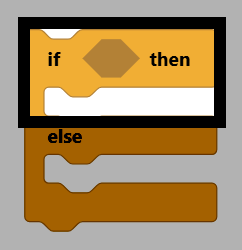
The if then branch#
An if/else block has two parts. In the if then branch, you insert a Boolean block into the condition slot for the robot to check.
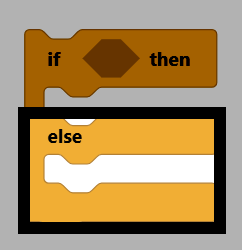
The else branch#
In the else branch, you add the blocks you want to run when the condition is false.
Insert a Boolean block#
Drag a Boolean block into the empty condition slot in the if then branch.
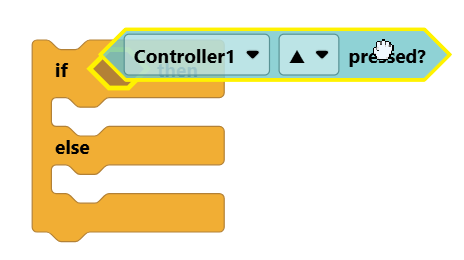
All Boolean blocks have sharp edges and a question mark in its name, such as the controller button pressed? block.
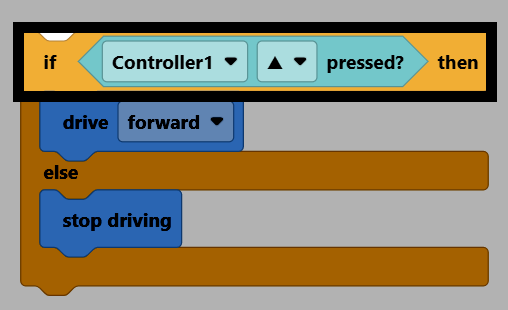
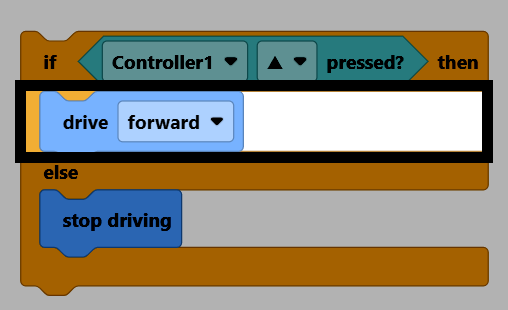
If the condition is true#
If the condition is true, the blocks inside the if then branch will run.
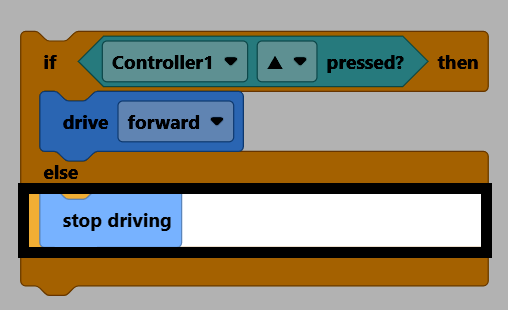
If the condition is false#
If the condition is false, the blocks inside the else branch will run.
Repeating if / else blocks#
An if/else block only checks its condition once. If you want the condition to be checked repeatedly, put the if/else block inside a looping block, like forever.
    forever
        if <[Controller1 v] [▲ v] pressed?> then
            drive [forward v]
        else
            stop driving
        end
    end
The if Block#
The if block is only the if then branch. If the condition isn’t true, nothing will happen.
    if <[Controller1 v] [▲ v] pressed?> then
        drive [forward v]
    end
The if / else if / else Block#
The if / else if / else block can be used to test multiple conditions one after another. It can be expanded to test as many conditions as needed.
    if <[Controller1 v] [◀ v] pressed?> then
        turn [left v] for (90) degrees ▶
    else if <[Controller1 v] [▶ v] pressed?> then
        turn [right v] for (90) degrees ▶
    else if <[Controller1 v] [A v] pressed?> then
        stop driving
    else
        drive [forward v]
    end